


NCV Blood Test: What It Really Is and When You Need It
Few medical terms cause as much confusion as this one. Many people hear "NCV" from a doctor and search for an NCV blood test, expecting a simple sample draw. In reality, NCV stands for nerve conduction velocity, and the test uses small electrical pulses, not a needle. If you are looking into an NCV test in Bangalore, this guide explains what the test measures, how to prepare and what happens on the day.
Why People Search for an NCV Blood Test
The mix-up is understandable. Doctors often write NCV on the same prescription as blood investigations such as sugar, vitamin B12 or thyroid tests. Both are done at diagnostic centres, so the two get lumped together.
They answer different questions:
-
Blood tests look at chemistry inside your body, such as glucose levels or vitamin status.
-
NCV looks at how well your nerves carry electrical signals.
Together, they often give a fuller picture of why you have tingling, numbness or weakness.
What NCV Actually Measures
Nerves work like wiring. When a nerve is healthy, signals travel quickly and strongly. When it is damaged or compressed, signals slow down or weaken.
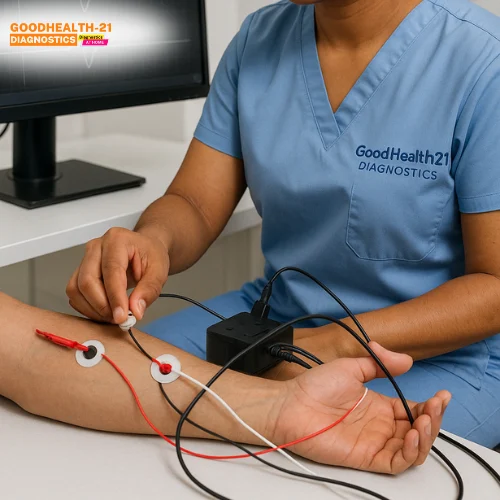
During the test, small electrodes are placed on the skin over a nerve. A brief, mild electrical pulse is delivered, and the response is recorded. The machine calculates two things:
-
Speed: how fast the signal travels along the nerve
-
Strength: how large the response is when it arrives
Doctors compare these values with normal ranges to see whether a problem lies in the nerve itself, the protective covering around it or a point of compression.
When Doctors Recommend an NCV Study
Your doctor may advise this test if you have:
-
Tingling, burning or numbness in the hands or feet
-
Weakness in a limb or difficulty gripping objects
-
Pain shooting down the arm or leg
-
Symptoms suggesting carpal tunnel syndrome
-
Suspected nerve damage linked to diabetes
-
Pain or weakness after an injury
-
Sciatica-type symptoms that need clarification
The test helps doctors work out which nerves are involved and how severe the problem is. It does not diagnose a condition on its own. The result is read together with your symptoms and examination.
Blood Tests That Often Go Alongside
Because several conditions can affect nerves, doctors commonly order blood work in parallel. These may include:
-
Fasting blood sugar and HbA1c, to check for diabetes
-
Vitamin B12 levels, since a deficiency can cause nerve symptoms
-
Thyroid profile
-
Kidney function tests
-
Complete blood count
If you have been told to bring both sets of results to your follow-up visit, do so. They complement each other.
Preparing for Your NCV Blood Test Visit
Preparation is straightforward, and a few habits help the readings come out accurately.
-
Bathe or wash the area beforehand. Clean skin gives better contact with the electrodes.
-
Skip creams, oils and lotions on your arms and legs on the day.
-
Stay warm. Cold limbs slow nerve signals and can affect results. In cooler months, keep your hands and feet covered on the way in.
-
Wear loose clothing that is easy to roll up above the elbow or knee.
-
Tell the staff about medical devices. Mention a pacemaker, defibrillator or any implanted device.
-
Mention blood thinners. This matters more if a needle study is also planned.
-
Carry your prescription and earlier reports. This includes blood tests and any scans.
You can usually eat normally unless your doctor has asked you to fast for accompanying blood work.
What Happens During the Test
You will sit or lie comfortably while the technician places small sticker-type electrodes on your skin. A brief pulse is then delivered over the nerve.
Most people describe the sensation as a quick tap, tingle or mild jolt. It can feel odd, particularly for the first few pulses, but it should not be severely painful. Tell the technician if it becomes too uncomfortable.
The visit usually takes 20 to 60 minutes, depending on how many nerves need testing. You can go back to your routine straight afterwards.
What About EMG?
Sometimes NCV is combined with electromyography (EMG), which checks the electrical activity of muscles using a very fine needle. This is a separate step and is done only when your doctor feels it is needed. The doctor performing the test will explain it beforehand.
Choosing a Centre in Bangalore
Quality depends heavily on who performs and interprets the study. Before booking what you think of as an NCV blood test, ask a few simple questions:
-
Who performs the test, and who reports it? A trained neurologist or neurophysiologist is ideal.
-
Is the equipment modern and regularly calibrated?
-
Will the report include nerve-by-nerve values and an interpretation?
-
Can a digital copy be shared with your doctor?
-
Is the room kept warm, which matters for accuracy?
Traffic can turn a short trip into a long one, so choose a convenient location and book a slot that suits your commute. Arriving rushed and flustered does not help you relax.
Understanding Your Report
A report may list terms such as latency, amplitude and conduction velocity. These numbers look technical, but they only make sense in context. A slightly low value does not always mean serious disease, and a normal result does not always rule out a problem. Take the report to the doctor who ordered it, and discuss the results alongside your blood tests and symptoms.
Conclusion
The name causes confusion, but the test itself is simple: it measures how well your nerves conduct signals. If someone has asked you to get an NCV blood test, remember that it is a nerve study and that any blood work will be done separately. Prepare as advised, carry earlier reports and choose a centre with experienced staff. Clear information leads to better questions and more useful answers from your doctor.
Frequently Asked Questions
1. Does NCV involve drawing blood?
No. NCV uses small electrodes and mild electrical pulses. Any blood tests ordered with it are collected separately.
2. Is the test painful?
Most people feel a brief tingling or tapping sensation. It is uncomfortable for some but usually well tolerated.
3. How long does the test take?
Usually 20 to 60 minutes, depending on how many nerves are being studied.
4. Is the test safe?
Yes, for most people. Tell the staff if you have a pacemaker or any implanted electronic device before the test begins.
5. When will I get my report?
Many centres provide it the same day or within a day. Confirm the timing when you book.

 English
 Arabic
 French
 Spanish
 Portuguese
 Deutsch
 Turkish
 Dutch
Dutch
 Italiano
 Russian
 Romaian
 Portuguese (Brazil)